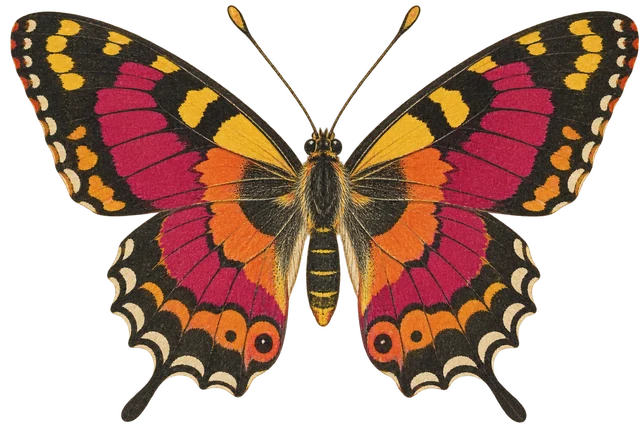
These are the butterflies that inspired four of my workshops.
E. A. Séguy’s butterflies make my brain fizz.
Seriously. Look at them.
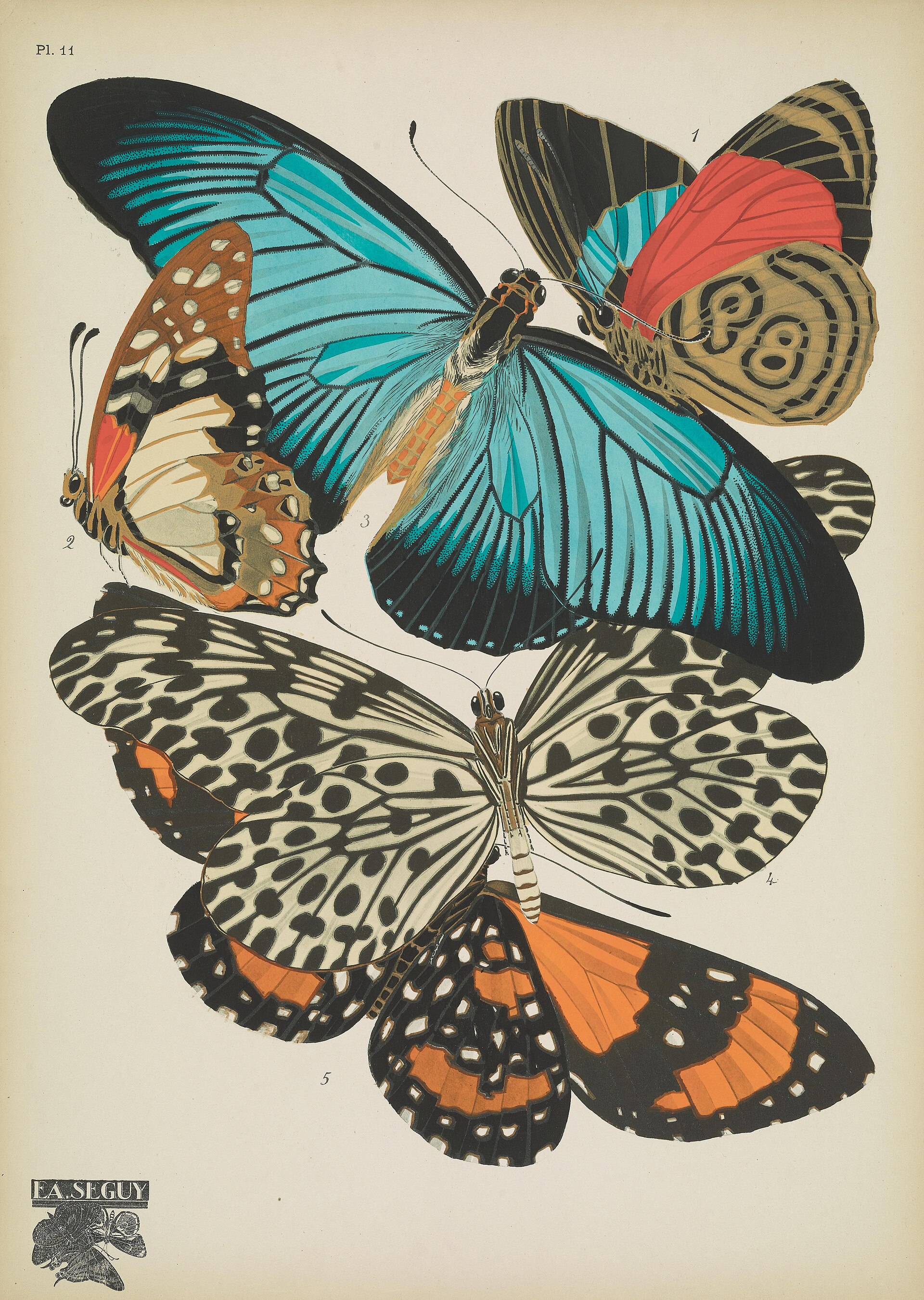
The colours are so vibrant they make real butterflies look underdressed, like they are wearing business formal at Eurovision.
Séguy was a prolific French designer from the early twentieth century who made beautiful images of insects using pochoir, a stencil-printing technique. Pochoir is complicated, weirdly pedantic and exact and, really, really fun.
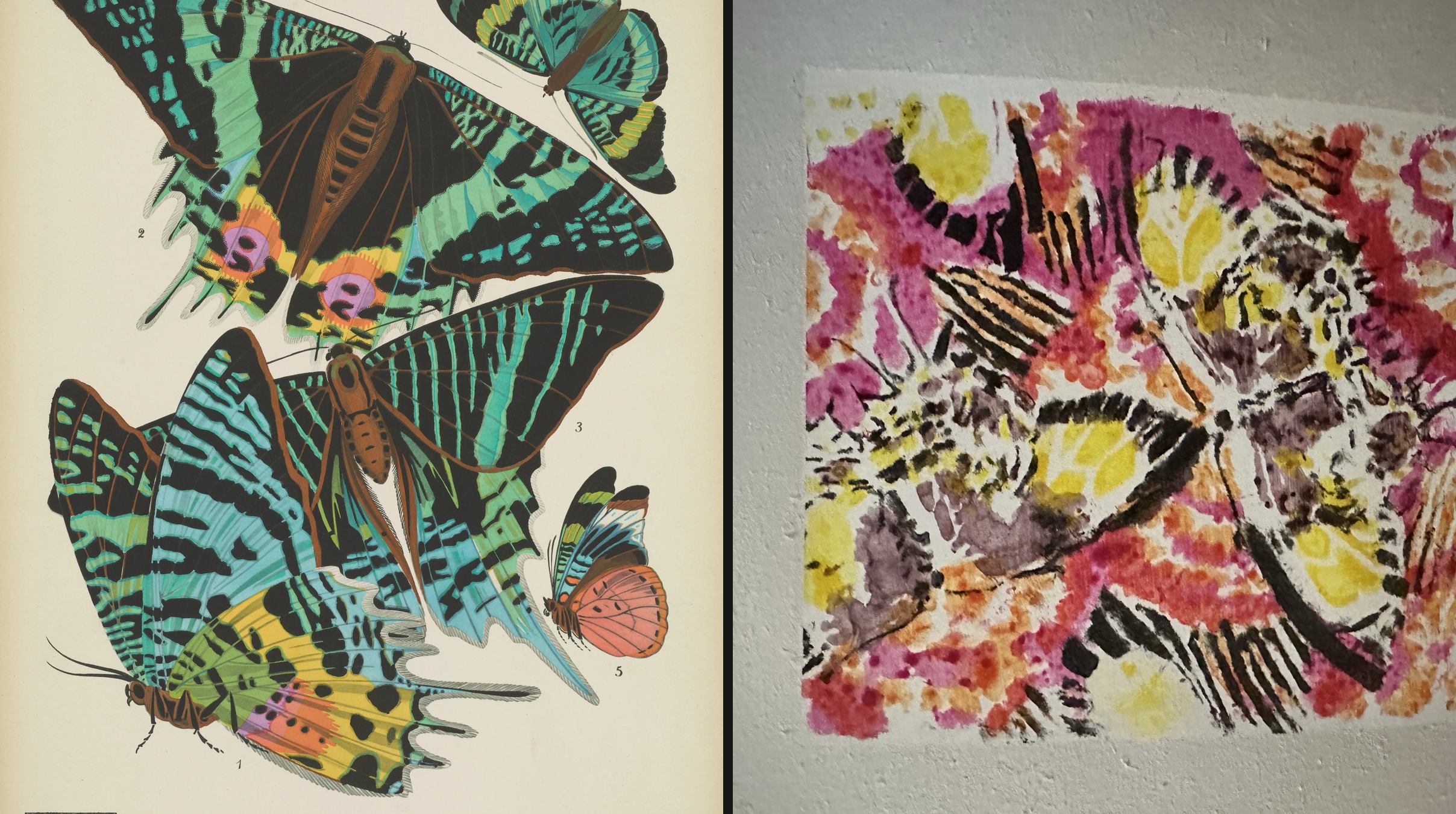
Apart from my newly inspired love of pochoir (the repetition, the precision required, breaking things apart into shapes to make a whole... the steep learning curve... mwah!), the insects, stencils, colour and pattern got me thinking about how science, art and the act of observing are connected.
The colliding concepts made me think that there might be a workshop lurking in there somewhere. Even better, Séguy doesn’t stop with beautiful entomological images.
In Papillons, naturalistic illustrations of butterflies eventually give way to decorative patterns inspired by their wings, likely intended as inspiration for textiles, wallpaper and other design.
Fashion and graphic design joined the party, and brought their wall treatments and furniture with them.
So now we’ve got:
insects → observation → science → illustration → stencil → colour → pattern → design → interior decoration
There couldn’t be a better reason to slide into an internet rabbit hole and not climb out for hours (or days). Important safety guidelines for the journey include avoiding disembodied smiles or food products labelled “Eat Me” or “Drink Me”.
How workshops are born
I rarely sit down and think:
Today I shall devise an educational program addressing visual literacy, biological sciences and creative practice.
I used to do that on occasion, back when I was paid by the hour to do so.
Nowadays, with no one here to stop me from following the rabbits in waistcoats (and the dopamine), I avoid that kind of structured program brainstorming unless absolutely necessary. It sounds exhausting. And, not incidentally, a little dull.
Instead, my process starts with finding something interesting to me. The pedagogical excuse being that passion is contagious.
That intriguing concept collides with another related concept and so on, until the conceptual carnage of a 20-concept pile-up on the internet highway resolves itself into the shape of a workshop.
Séguy is magical for this kind of process because you can start almost anywhere.
Start with the insect and you’ve got biology, symmetry, camouflage, mimicry and colour.
Start with pochoir and suddenly you’re elbow-deep in ink, paint, stencils, printmaking and layers (and layers and layers) of reproduction.
Start with the patterns and you’ll find yourself exploring textiles, wallpaper and design, historical and modern art, and the psychology of mark-making.
Starting with colour requires a search party, a map and an obscene amount of art supplies...
Did you know that it’s not quite accurate to think of colour as something an object simply has? What we experience as colour emerges from light interacting with materials and structures, and then with our visual system. Butterfly wings make this particularly interesting because some colours can be produced by microscopic structures rather than pigment.
But I digress...
My point, I think, or at least the point I find useful when designing programs, is that a concept sparked by Séguy does not have to become a talk or workshop that even mentions Séguy.
The first interesting thing signposted on the map of your curious journey through linked concepts does not have to become the subject of the workshop you are planning.
Sometimes it’s just a signpost to somewhere interesting and accessible on a broader level.
Is staring at things science?
Prior to my recent wanderings through museum catalogues and the Internet Archive, I thought about scientific illustration as someone doing science and then hitting up an artist to make it look pretty, if I thought about it at all.
Which I probably didn’t.
It seems obvious in retrospect, but, as all those folk out there more educated in this topic than I am will know, drawing was one of the ways people recorded and investigated what they were seeing.
If you’re drawing an insect, plant, bone or cell, you have to look at it carefully...
Where does that bit join?
Is that shape repeated?
Does every specimen have it?
Is the thing I think I’m seeing actually there?
Drawing is almost a perfectly designed mechanism to force you to notice details.
Which makes drawing itself rather useful to science, and gives me yet another reason to incorporate art into my workshops as often as possible.
My most recent pilot workshop was prompted, at least in part, by organised jellyfish and brains drawing brains.
Bear with me.
Scientific art can get pretty weird.
History usually does.
Our carefully separated categorical thinking collides and makes pretty patterns as everything gets wonderfully tangled.
Haeckel and the very organised jellyfish™
I feel like this is a children’s book waiting to happen.
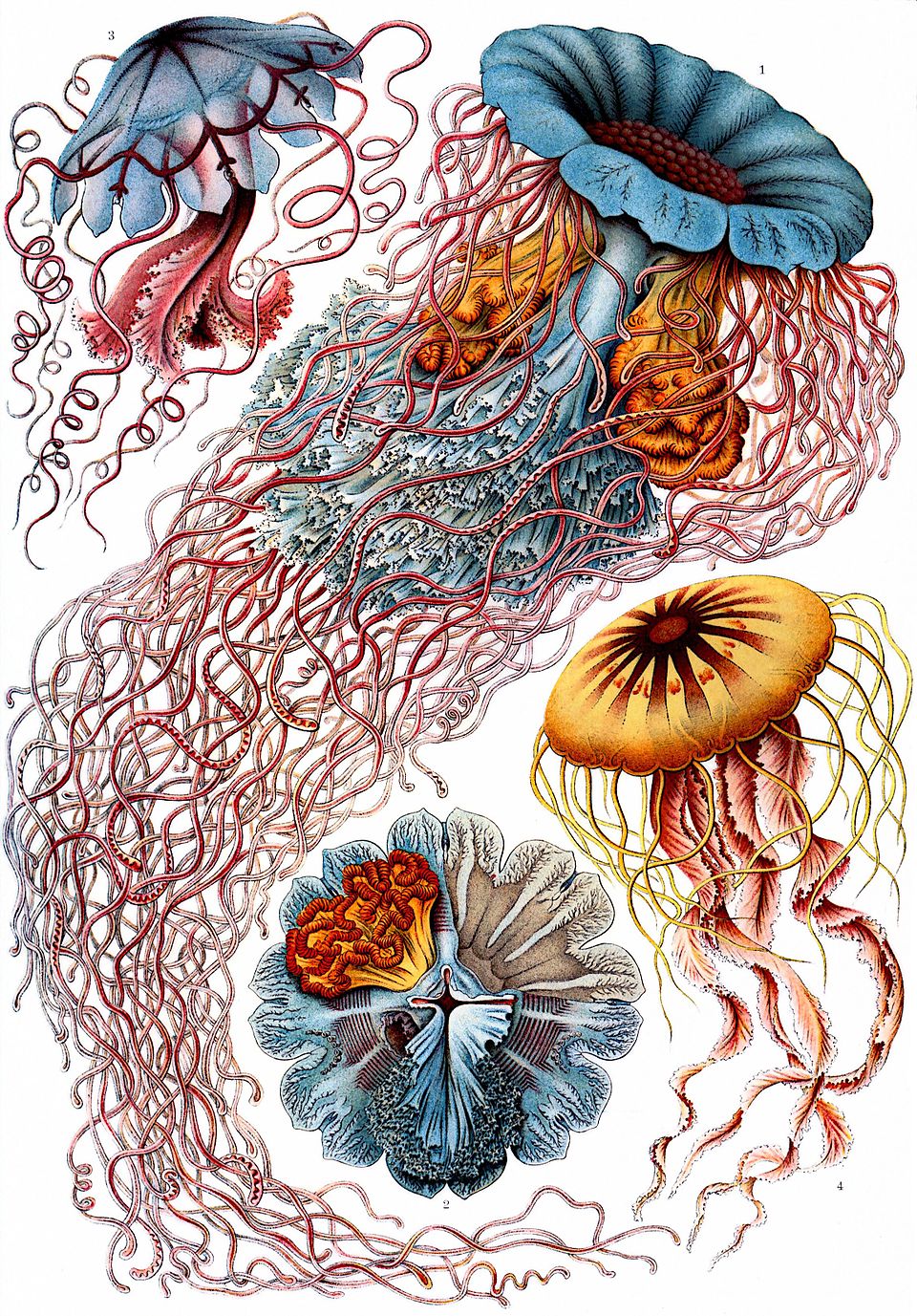
Ernst Haeckel was a nineteenth-century German biologist, evolutionary thinker and accomplished illustrator who illustrated enormous numbers of organisms, including radiolarians, jellyfish and other tiny marine creatures that are frankly showing off.
His Kunstformen der Natur, or Art Forms in Nature, is gorgeously and intricately illustrated. You’ll likely recognise some of the squids and jellyfish even if you’ve never knowingly encountered Haeckel before.
On many pages, his creatures are arranged into elaborate symmetrical compositions. Look at a page from a distance and it could be decorative art. Close up, you are looking at organisms arranged for scientific comparison, but still infused with wonder.
Haeckel was fascinated by classification, evolution and what he saw as an underlying order in nature.
Like many a cartoon supervillain, however, he took his enthusiasm for hierarchy to some very dark places.
Haeckel explicitly arranged human groups into a racial hierarchy. Those ideas belong to the history of scientific racism and, to put it mildly, are scientifically indefensible and morally repugnant.
And yet... his pictures radiate wonder and a love of the natural world.
Sadly, this kind of contradiction is common, and hugely inconvenient when choosing topics for investigation.
You can simultaneously be knocked sideways by somebody’s images and want to knock them down and stomp the racism out of them.
Those weird and wonderful sea creatures didn’t stay politely in the science books either. They escaped into art and design, becoming part of the tangle of natural forms that fed Art Nouveau.
So:
nature → scientist → drawing → artist → design
Science bumps into art and wanders off with pickpocketed spoils: precise geometry, radial symmetry, swirling organic forms and the sort of patterns that make our pattern-and-beauty-craving brains sigh contentedly.
And I’m prompted to remember that we draw brains using our brains
(And opposable thumbs, incidentally)
Which leads me to drawings of a brain.
Well, bits of one.
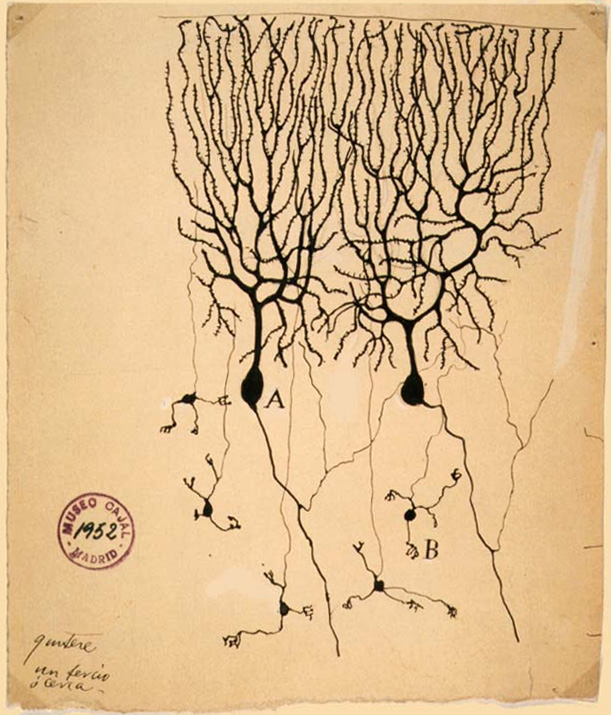
Santiago Ramón y Cajal studied nervous tissue under a microscope and drew what he observed.
His neurons make mine dance!
They branch across the page like trees, roots, seaweed, maps, lightning and several things my brain hasn’t identified yet.
These weren’t illustrations made because Cajal did some doodling after work.
Armed with microscopes, staining techniques, pen and paper, Cajal used drawing as part of the process of observing and documenting nervous tissue. Those observations helped him develop the neuron doctrine: the understanding that the nervous system is made up of individual nerve cells rather than one continuous network.
In 1906, that work earned Cajal and Camillo Golgi the Nobel Prize in Physiology or Medicine.
And, in rather less exalted circles, those drawings helped inspire Brain Games.
More than a century later, we put the drawing part of that work in art galleries.
Which is where the distinction between art and science gets beautifully blurry.
Cajal used drawing to investigate the brain. I look at his drawings and immediately start thinking about Neurographica, automatic drawing, branching patterns, doodling and what happens in our brains when we make marks.
That’s another rabbit hole.
And another workshop.
My possibly irresponsible recommendation?
If you’re programming workshops, particularly in libraries, museums, schools or community spaces, you don’t necessarily need to start with:
What craft should we do? What lessons do I want to impart?
Start with something interesting to you.
A strange object.
A scientific drawing.
A historical photograph.
An insect with absurd wings.
A material you’ve never used.
A person who spent forty years drawing microscopic sea creatures.
Then play conceptual frisbee.
You don’t need to cram every connection into the resulting workshop.
Unless you are looking for a two-hour lecture with glue sticks.
The connections map your research journey, your intellectual wandering through the terrain.
The workshop is in the postcards you send home, your sketchbook from your travels and the holiday snapshots that inspire other people to visit similar terrain.
Séguy might give you a workshop on mimicry.
Haeckel could give you symmetry and an invitation for people to invent organisms.
Maybe Cajal gives you drawing and brains.
Or you could end up visiting somewhere completely different.
It’s entirely possible that nobody attending the workshop ever hears you mention any of the names that inspired you to create the particular terrain they get to explore.
Totally fine.
The exploratory research is for you. It both refines your ideas and sparks new ones.
Connecting people through connected ideas is useful work worth doing.
The fact that researching it is way more fun than perhaps it should be... shhh... that can remain our little secret.
Because learning doesn’t have to announce itself portentously before it enters the room.
It can slowly emerge from the jumble of conceptual threads you gather on a wild ride down an internet rabbit hole.
Sometimes, the science sneaks in with the butterflies.