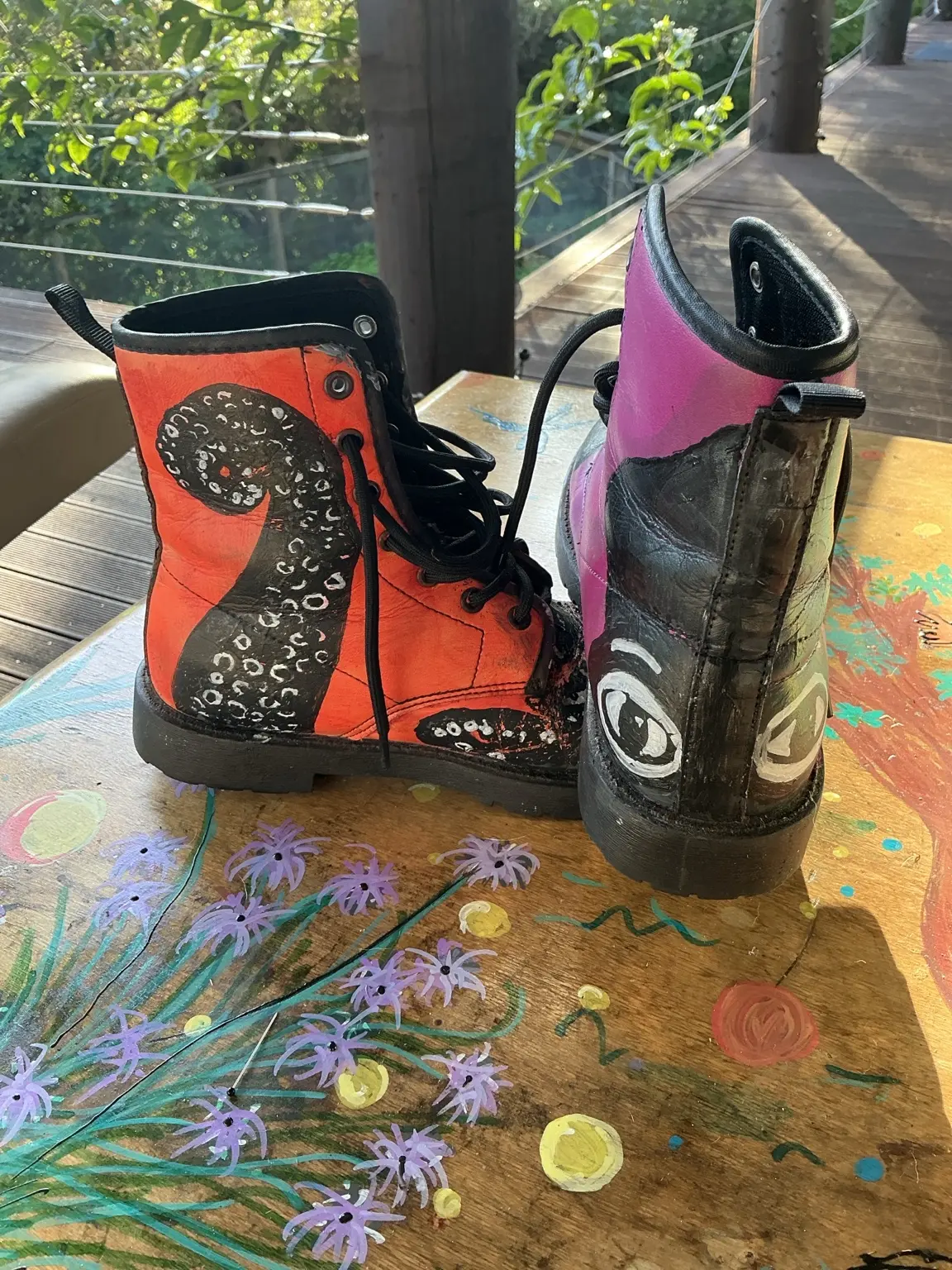
And yes, before anyone emails me from the Nautical Pedantry Society:
I know squid don’t have suckers like that.
The boots are biologically dubious.
Which somehow feels relevant.
Because the fear isn’t really about the squid.
It’s about accidentally becoming visible.
Not mild nerves either.
Not: will people think these are odd?
I mean the brief, electric, heart-stopping kind.
That horrible little drop in your chest.
Like missing a stair in the dark.
For maybe two seconds, my brain becomes entirely convinced that wearing hand-painted octopus-squid hybrid boots to a workshop is equivalent to handing strangers a diary and asking them to grade it.
Then I remember I am an adult woman running a cat toy engineering workshop for teenagers, not a medieval heretic awaiting sentencing.
Still, the fear is real.
Not because the boots are embarrassing.
Because they are evidence.
Evidence that I made something unnecessary on purpose.
Evidence that I had an idea and cared enough to drag it into physical existence.
Evidence that something existed in my head first, and I voluntarily allowed it into public where other people could look at it.
It’s terrifying.
Which is complicated further by the fact the boots are not entirely terrible.
If they were genuinely awful, the whole thing could be safely ironic.
Unfortunately, they contain traces of actual effort and affection.
Because showing people things you made can feel weirdly close to showing them yourself.
Like handing someone a little fragment of your internal landscape and hoping they don’t react with a quizzical, embarrassed and slightly scornful look before firmly redirecting the conversation.
It has the emotional impact of being five years old and showing your mum a blob with legs you’re deeply proud of, then getting “the look.”
Not cruelty—confusion, dismissal, amusement when you wanted warmth.
That expression that says: “Oh! You thought this mattered.”
I suspect that is why I still react with confusion and horror when people call me an artist.
It’s weird.
Like they’re placating me the way adults humour a child desperately seeking attention and affirmation.
People do say it, though. Often. Sometimes with alarming confidence. It’s an occupational hazard when you call your business Artistic Disorder.
Meanwhile, I think of myself as someone who makes concepts into objects when possessed by a highly specific enthusiasm.
“Artist” feels too premeditated and intentional. Far too fancy a word—with far too much cultural resonance, intellectual rigour and history.
Like I should understand gallery lighting, own far fewer types of glue, and possess an educated and articulate grasp of colour theory.
Creativity, allegedly
I also don’t think I’m especially creative.
Not in the mystical sense people often mean it.
Creativity, to me, seems less like magic and more like adaptation mixed with really specific aesthetic or functional preferences.
Some people can create wealth from spreadsheets.
Some can train their bodies with such consistency and precision they become amazing athletes.
I know people who understand business instinctively, people who can maintain routines for years, and people who can sell absolutely anything.
These abilities feel completely alien to me.
I look at disciplined expertise in other people the way Victorian sailors probably looked at bioluminescence.
With awe.
And mild suspicion.
Meanwhile, my own brain apparently specialises in things like:
“What if I tied skimpily dressed Barbies to op-shop lamps with glitter string, installed a red lightbulb, and added a label saying because it’s art?”
Which, for the record, has made me $120 a pop more than once. Which is utterly ridiculous—but true.
I still don’t entirely know what that label meant.
What does “because it’s art” actually mean?
People more intelligent than I have spent decades—centuries, even—fighting over that question in galleries, cafés and universities while dramatically gesturing with nicotine- and paint-stained hands.
If art is primarily technique, I cannot claim to be an artist. Which, for the record, I don’t.
Technique matters. I aspire to it.
Unfortunately, practice for me usually gets sidetracked into:
but what if I did that … or this?
Before I can blink, I’m covered in paint and standing in front of a strange hybrid object bearing absolutely no relation to whatever “exercise” I was supposedly attempting.
The gap between the idea and the object
I feel like other people possess some ability I fundamentally lack.
The ability to slow down and refine things. To obtain mastery. I’m a dilettante.
My brain and hands are desperate for the thing to arrive in the physical world fully formed. I’m sure the object already exists somewhere beyond me, and I’m volunteering to drag it into reality quickly before it disappears again.
There must be a perfect conceptual object somewhere. Sadly, the physical version can never fully survive translation into matter intact.
Was it Plato with the ideal forms?
People only get to see the echo. The maker sees the gap between the ideal form and the object in our imperfect world.
And the gap can feel humiliating.
I look at the squid boots and see:
uneven lines,
compromises,
places where execution failed.
Other people see:
creativity.
They see someone likely to own glue guns, old books and a sewing machine from the seventies.
Someone who might let them make weird things without embarrassment.
The boots communicate something before I’ve even spoken when I wear them to workshops.
Not polish.
Not mastery.
Permission.
Which is pretty much the entire foundation of how I facilitate.
You do not need to be brilliant before you begin.
You do not need permission to participate.
You do not need technical mastery before your ideas are allowed to exist publicly.
I believe this wholeheartedly for other people.
Applying it to yourself is another matter entirely.
Because facilitating creativity and claiming space as a creative are psychologically different beasts.
Facilitating says:
“Look what you can do.”
Making says:
“This came from me specifically.
You may now admire it.”
And that second thing still feels perilously close to being skinned alive emotionally.
Not because criticism hurts, exactly.
Because visibility does.
What keeps leaking out
And the strange part is that none of this was intentional.
I never consciously decided to Become An Artist™.
I was building workshops.
Making strange useful things.
Following concepts.
Teaching.
Experimenting.
Amusing myself.
Externalising ideas.
Then apparently traces of me leaked into the world strongly enough that other people started identifying a coherent creative voice before I did.
The squid boots were never:
“Behold my art.”
They were:
“Wouldn’t it be funny if…”
And then suddenly I was standing in public wearing a psychological fingerprint on my feet.
That’s the uncomfortable part.
Not:
“People noticed the boots.”
More:
“People noticed the pattern.”
The compliments on embroidery work.
The surprise when people realise you made the clothes you’re wearing.
The strange objects friends refuse to throw away.
The random 3am paintings hanging on someone else’s wall years later.
The lamp Barbies.
The squid boots.
Not because you consciously decided to Become An Artist™.
But because making keeps leaking out of you whether you authorise it or not.
Which means the really uncomfortable possibility is this:
Perhaps art is not a title granted by technical perfection.
Perhaps sometimes it’s simply what happens when enthusiasm repeatedly overpowers propriety.